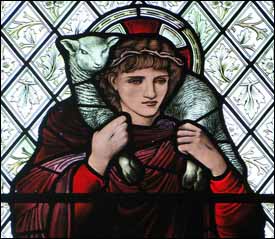
Edward Burne-Jones, 'Good Shepherd' stained glass window (1895), Harris Manchester College, Oxford.
When you read the book of Lamentations in the Old Testament, it can seem pretty grim. Jeremiah mourns the destruction of Jerusalem by the Babylonians in 586 BC. The book's chapters repeat one dismal lament after another, line after line. It's crushing -- and reflects the way the Israelites feel after this massive defeat and exile. But the dark lament finally gives way to hope.
"21But this I call to mind,and therefore I have hope:22The steadfast love of the LORD never ceases;his mercies never come to an end;23they are new every morning;great is your faithfulness.24'The LORD is my portion,' says my soul,'therefore I will hope in him.'" (Lamentations 3:21-24, ESV)
In spite of the bitter circumstances, God's character shines forth.
The author highlights three aspects of the Lord's character -- his love, his mercy, and his faithfulness. Let's look at these.
In our text, the words are clearly related to each other. Each underscores a part of God's gracious, steadfast character that brings us hope. This is the character revealed to Moses as Yahweh passed before him on Mt. Sinai (and is repeated many times in the Bible[4]).
"The LORD, the LORD,a God merciful[5]and gracious,[6]slow to anger,and abounding in steadfast love[7]and faithfulness."[8](Exodus 34:6)
The character words in our text -- steadfast love, mercies, faithfulness -- are used in parallel, as saying something similar. This shouldn't surprise us, since one of the chief characteristics of Hebrew poetry is parallelism.
God's character, God's mercies never end, are never depleted, never quit. You see the parallelism in verse 22.
Several modern translations (ESV, NRSV, NJB, and NASB) capture this well.[11]
When you get to verse 23, this actually seems like triple parallelism, intensifying the idea all the more.
And these three lines are capped off with a conclusion based on what they assert: "Great is your faithfulness!" God, your mercies never quit -- ever -- thus your faithfulness must be very great indeed!
Let's meditate for a moment on the phrase, "they are new every morning." "New" isḥādāsh, "new, new thing, fresh," from the verb "to renew, repair."[12]At night I'm tired, my muscles may be sore, I am exhausted. But by the time I've had a good sleep, I wake up renewed, refreshed. God's mercies are like that. Every morning they're renewed, refreshed, ready to go. They never quit.
The depressing, repetitious lament of the first part of Lamentations is broken when these verses appear:
"22The steadfast love of the LORD never ceases;his mercies never come to an end;23they are new every morning;great is your faithfulness." (Lamentations 3:22-23)
And the author exclaims:
"'The LORD is my portion,' says my soul,'therefore I will hope in him.'" (verse 24)
The verb "to apportion, allot" often occurs in the sense of territories in the Promised Land being apportioned out to the twelve tribes of Israel (Numbers 26:53). In verse 24, we're reminded that Yahweh himself is "my portion,"[13]the "territory" apportioned out to me, if you will (Psalm 16:5; 73:26; 119:57; 142:5; Jeremiah 10:16; 51:19). He is mine. I have a share in him. I have a right to claim him and his promises. I have a right to hope in his promises. I'll take my piece of that firm hope and hang on to it! Yes, I will!
My friend, are you discouraged, depressed? Have circumstances crushed you like the fall of Jerusalem crushed the Israelite exiles? Then call these verses to mind as the basis of renewed hope for you. His steadfast love and compassions are yours; as his child you have a right to them. His faithfulness is for you! And his love never, ever runs dry. It is never depleted. It never ends for you. Every morning his mercies are there for you afresh. Hallelujah. Take hold of them, they are yours, through Jesus Christ our Lord
Father, thank You that You are the God of mercies. That You show us the depth of Your compassion for us on the cross. Help us to lay hold afresh on You. In Jesus' name, we pray. Amen.
One of the songs I often sing when I meet afresh with the Lord in the mornings are these verses set to music by Edith McNeill.[14]Why don't you let these words refresh you right now as you listen to it onYouTube.
End Notes & References
[1]For centuries the nounḥesedwas translated with words like "mercy, kindness, love." The Greek Septuagint usually useseleos, "mercy," and the Latin Vulgatemisericordia. In the twentieth century, however, some Bible scholars began to understand this word in terms of faithfulness to covenant obligations. For example, Holladay definesḥesedas (1) "obligation to the community," loyalty and solidarity towards relatives, friends, guests, etc. Lasting loyalty, faithfulness (hence translations such as "steadfast love" [RSV, ESV, NRSV]). Then, (2) "faithfulness, kindness grace" towards people or individuals (William L. Holladay,A Concise Hebrew and Aramaic Lexicon of the Old Testament, based on the Lexical work of Ludwig Koehler and Walter Baumgartner(Grand Rapids: Eerdmans / Leiden: E. J. Brill, 1988), p. 111. But it's not that simple.
[2]The verb "refers to deep love (usually of a 'superior' for an 'inferior') rooted in some 'natural' bond." When used of God, the word incorporates two concepts: first, the strong tie God has with those whom he has called as his children. Second is God's unconditioned choice: He is gracious and merciful to whomever he chooses (Exodus 33:19) (Leonard J. Copps,rāḥam,TWOT #2146b).
[3]The basic root idea ofʾāmanis firmness or certainty. The word describes God's utter dependability (Jack B. Scott,ʾāman, TWOT #116e).
[4]Psalm 86:15; 103:8-10; 145:8; Joel 2:13; Numbers 14:18; Nehemiah 9:17; Micah 7:18.
[5]Raḥûm, from the verbrāḥam, "to show compassion."
[6]Hannûn, "gracious," from the verbḥānan, be gracious; pity" (TWOT #694d).
[8]ʾEmet,"firmness, truth," from the verbʾāman, "to be established, be faithful" (TWOT #116k).
[9]The verb istāmam, "be complete, finished." It it can mean "be finished, come to an end, cease" or perhaps, "be consumed, exhausted, spent" (Francis Brown, S.R. Driver, and Charles A. Briggs,A Hebrew and English Lexicon of the Old Testament("BDB"; Clarendon Press: Oxford, originally published 1907, reprinted with corrections 1953), p. 1070, meanings 3 or 5).
[10]The verb in verse 22b is the verbkālâ, "accomplish, cease, consume, determine, end, fail, finish," with the root idea, "to bring a process to completion" (John N. Oswalt,kālâ, TWOT #982).
[11]The NIV and KJV render verse 22 as "Because of the LORD's great love/mercies we are not consumed," while the ESV, NRSV, NJB, and NASB render it, "The steadfast love of the LORD never ceases." I think these translations are on the right track, because they support the clear parallelism between the first line and the second line.
[12]Hādāsh, TWOT #613a.
[13]"Portion" isḥēleq, "share, part, territory," from the verbḥālaq,"share, divide, allot, apportion, assign." The verb is used in parceling out portions of land (Donald J. Wiseman, TWOT #669a).
[14]"The Steadfast Love" by Edith McNeill, © 1974, Celebration.