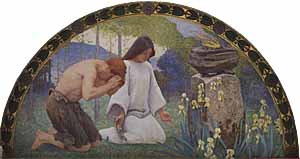
Charles Sprague Pearce, 'Prayer' (1886), mural in the north corridor, Great Hall, Thomas Jefferson Building at the Library of Congress, Washington DC.
We humans tend to begin spiritual things with enthusiasm, but after a while fall back into lethargic default patterns. We realize that we've slacked off, but we can't seem to summon the energy to get moving again. We say we mean well, but our excuses for our spiritual laziness are lame. Our heart just isn't in it. We become sluggish. Dull of spirit. Stagnant. Complacent.
In a wonderfully winsome passage (Hosea 6:3), God woos his complacent people to return to their first love.
"Let us know;let us press on to know the Lord;his going out is sure as the dawn;he will come to us as the showers,as the spring rains that water the earth." (Hosea 6:3, ESV)
Let's examine the verse. Two key verbs lie at the heart of the exhortation: "know" (NIV "acknowledge") and "press on."
"Let usknow;let us press on toknowthe Lord...." (Hosea 6:3a)

The Hebrew word for "know" (yādaʿ) is used nearly 1,000 times in the Old Testament, with many shades of meaning, even as a euphemism for sexual intercourse. The unfortunate NIV translation "acknowledge" is possible, but unlikely.1Most modern translations see the connotation here as of knowing a person, "know, get to know, become acquainted with."2The verb is used for the most intimate acquaintance. God knows Moses by name (Exodus 33:17) and talks to him face-to-face (Deuteronomy 34:10). Hosea exhorts us to "know" Yahweh personally. To reach out to him again, to seek him, to try to understand his ways and values, and to walk in them.
"Let us know;let us press on to know the Lord...." (Hosea 6:3a)
The second line repeats the exhortation "to know," but adds urgency. "Let us press on to know the Lord." "Press on" (NIV, ESV, NRSV), "follow on" (KJV) is verbrādap, "pursue," here, "push on to (know)."3The word has the idea of setting off after someone to catch up with him.4This isn't a passive idea. It requires action. Urgency. Now! We must make an effort to catch up with Yahweh so we can get to know him.5
The alternative to diligently seeking the Lord is a kind of spiritual passivity.
"Woe to you who arecomplacent6in Zion...." (Amos 6:1a)
Comfort, tranquility, being "at ease in Zion" is not the posture God desires. Rather, we need a sense of urgency, of hunger that compels us to draw close to him. To the church at Laodicea, Jesus says,
"I know your deeds, that you are neither cold nor hot. I wish you were either one or the other! So, because you are lukewarm -- neither hot nor cold I am about to spit you out of my mouth." (Revelation 3:15-16)
A hot drink warms you on a cold day. Cold water refreshes. But lukewarm? No! Sometimes we are in danger of placid inactivity towards God.
I think of coasting on a bicycle. You can't coast uphill, but on level ground or on a slight slope, you can go miles without pedaling. The writer of Hebrews warns us.
"We must pay more careful attention, therefore, to what we have heard, so that we do notdrift away." (Hebrews 2:1)
You can lie snoozing on an air mattress without a care in the world, but the lazy, slow, incessant current will take you far downriver before you know it.
"We do not want you to becomelazy, but to imitate those who through faith and patience inherit what has been promised." (Hebrews 6:12)
The adjective translated "lazy" here means "slow, sluggish, indolent, dull, languid."7
"... Notneglectingto meet together, as is the habit of some, but encouraging one another...." (Hebrews 10:25, ESV)
The verb here means, "forsake, abandon, desert," and suggests separating a connection with something.8When we excuse ourselves from meeting with other believers, we are rejecting one of God's chosen ways of keeping us sharp -- association and stimulation from God's word and from people intent on serving the Lord (Hebrews 3:13).
Our verse suggests a posture of leaning forward, pressing forward with urgency.
"Let us press on to know the Lord." (Hosea 6:3, ESV)If you've ever watched a sprint in the summer Olympics, you see the front runners leaning forward just as they reach the finish line, a technique known as "dipping." Leaning forward might just get them across the line a microsecond ahead of their competitor in a photo finish. It reminds me of Paul's zeal in his letter to the Philippians, depicting just such a sprinter stretching forward as he nears the finish line.
"One thing I do: Forgetting what is behind andstraining toward9to what is ahead,Ipress on10toward thegoalto win theprizefor which God has called me heavenward in Christ Jesus." (Philippians 3:13-14)
There is effort required. But there is also the wonderful blessing of seeking God with all our heart.
"Let us know,let us press on to know the LORD;hisappearing11is as sure as the dawn;he will come to uslike the showers,12like the spring rains13that water the earth." (Hosea 6:3, NRSV)
If we seek him, he will come out to meet us as predictably as the sun rises in the morning! "His appearing is as sure as the dawn." Hosea compares Yahweh's coming to us as refreshing showers after a dry spell, like spring rains that replenish the moisture of the soil so that growth can burst forth again.
Do you need the Lord's refreshing? Do you need his watering? Then reach out to him anew. Press beyond your current default level so that you might find him afresh. He'll come out to meet you -- as surely as the sun will rise in the morning. Press on to know the Lord, my friend. Press on!
Father, you know our frailty. Forgive us our passivity towards You. Renew in our hearts a hunger, a zeal to seek you with all our heart. To lean forward into You that we might receive Your refreshing, Your renewal, Your joyful peace. In Jesus' name, we pray. Amen.
End Notes & References
References and Abbreviations
[1]Yādaʿcan possibly mean "recognize, perceive" (from observation, deliberation) (Holladay 128, 3).
[2]Yādaʿ, Holladay, 128, 5.
[3]Rādap, Holladay 333, Qal 2.
[4]Rādap, Holladay 333, Qal 1.
[5]"Strive to know" (e.g., Christian Standard Bible, Complete Jewish Bible, Holman Christian Standard Bible), "so our best to know" (e.g., Contemporary English Version), "try very hard to know" (e.g., Easy-to-Read Version), "endeavor ourselves to know" (e.g., Geneva Bible, 1599), "pursue knowledge" (e.g., International Standard Version; New King James Version).
[6]"Complacent" (NIV), "at east" (ESV, NRSV, KJV) is the adjectiveshaʾănān, "at ease, untroubled, undisturbed" (Holladay, 357; TWOT #2304a), fromshāʾan, "rest, be quiet, be at east," the idea of being quiet and tranquil.
[7]Nōthros,Thayer, p. 431.
[8]Enkataleipō, BDAG 273, 2.
[9]"Straining toward" (NIV), "straining forward" (ESV, NRSV), "reaching forth" (KJV) isepekteinomai, "to exert oneself to the uttermost, stretch out, strain toward something" (BDAG 361).
[10]"Press on" is the verbdiōkō, to move rapidly and decisively toward an objective, hasten, run, press on," then "run after, pursue" (BDAG 254, 1 and 4).
[11]"Rises" (NIV), "going out" (ESV), "appearing" (NRSV), "is prepared" (KJV) ismôṣāʾ, "act or place of going out" (TWOT #893c), "(act of) going out" (Holladay 287, 4), from the verbyāṣāʾ, "go out, come out, go forth."
[12]"Showers" (NIV, ESV), "winter rains" (NIV), "former rain" (KJV) isgeshem, "rain, shower" (TWOT #389a). The "former rain" (môreh) begins the season of rain in the second half of October to November (A Denis Baly, "rain," ISBE 4:36).
[13]"Spring rains" (NIV, ESV, NRSV), "latter rain" (KJV) ismalqôsh, "latter rain, spring rain" occurring during March and April (TWOT #1127b).