James J. Tissot (1836-1902, French artist and illustrator), "David Praying in the Night," OT watercolour series. Jewish Museum, New York.
Psalm 139 is a probing psalm of David -- a wonderful but troubling psalm. Let's look at it together, especially the final two verses.
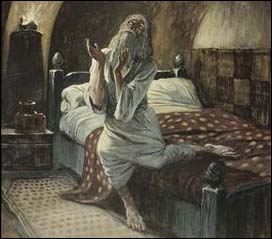
David realizes that God knows everything about him. Every detail -- even the hum-drum, innocuous details of his life. Every moment. Even when he sits down and when he stands up.
But not just his actions. His thought-life is exposed to the Creator.
"You discern my thoughts from afar." (Psalm 139:2b)
Even before David speaks, God knows what he is going to say. David feels God is spying on him, giving him no privacy whatsoever. And he's not so sure he likes this:
"You hem me in,1behind and before,and lay your hand2upon me." (Psalm 139:5)
Sometimes his presence is overwhelming. And when he lays his hand on us, we are powerless. Like it or not, God intervenes in David's life. So David contemplates escape, but finds no way to hide from God's pervasive influence (verses 7-12).
"Where shall I go from your Spirit?Or where shall I flee from your presence?" (Psalm 139:7)
There's a kind of restive rebelliousness visible in us at times. David senses it in himself.
But then David's mind turns to God's tender care over his life. God is not harsh but caring, careful, caring.
"For you formed my inward parts;you knitted me together in my mother's womb.I praise you, for I am fearfully and wonderfully made." (Psalm 139:13-14a)
Yet God is intrusive. Long has he cherished plans for David -- for good and not for ill (Jeremiah 29:11).
"In your book were written, every one of them,the days that were formed for me,when as yet there was none of them." (Psalm 139:16)
Sometimes the idea of God foreordaining events feels restrictive. Don't I haveanyfreedom of will at all? Is there no choice? Is it all predetermined? Do Ihaveto? (It sounds like a teenager with a parent.) But then David reflects on what he has learned about God's thoughts from a lifetime of seeking him.
"How precious to me are your thoughts, O God!How vast is the sum of them!If I would count them, they are more than the sand.I awake, and I am still with you." (Psalm 139:17-18)
This great God, who is infinitely more complex and knowing than David ever will be, somehow cares about him, about him as a person who is beloved. God's presence is not malevolent but benevolent. God doesn't seek to harm David but to bless him.
At both the beginning and the end of the psalm we see the idea of one's way or path.
"You search out mypath3and my lying downand are acquainted with all myways."4(Psalm 139:3)
In the psalm's last two verses, David comes back to this again, the possibility of a "grievous way," a habit or lifestyle that brings concern or grief to God's heart. It is possible, you know, to "grieve" or offend the Holy Spirit by what we do or say,5even by thoughts that are filled with bitterness, lust, self-centeredness, covetousness (Ephesians 4:29-32). We can cause sorrow to God, much like the sorrow of a parent who sees his son or daughter making wrong decisions and taking paths that we know will lead to pain and heartache for our child.
At the beginning, David seems to resent God's intrusion into his life and thoughts. Then he recalls God's tender formation of him and the vastness of God's knowledge, and he begins to soften. The limitless, omnipresent God loves him. And wishes him well. And so in the final two verses David surrenders, submits to God's loving scrutiny. In fact, he invites it.
"Search me, O God, and know my heart!Try me and know my thoughts!And see if there be any grievous way in me...." (Psalm 139:23-24a)
He invites God into his inner person to see what's there -- warts and all.
David now trusts God to perform on him what Alcoholics Anonymous refers to in Step 4 as "a searching and fearless moral inventory." David is finally willing to let down his guard. He asks God to do this using four active verbs:
"See if there is anyoffensive wayin me,and lead me inthe way everlasting." (Psalm 139:24, NIV)
Now we come back to "the way" that we saw in verse 3. David asks God, trusts God, to look deep within and help him discover if there is something within him that is a wrong path, a path that grieves the Father, a path that is inherently wicked and has no future. After all, the Proverbs tell us:
"There is a way that seems right to a man,but its end is the way to death." (Proverbs 14:12)
Finding the right path is so important. Jesus tells us:
"Broad is the way that leads to destruction...." (Matthew 7:13)
God can help us see the road we're on. So may a Christian friend whom God sends to assist us at this crossroad in our lives. Jeremiah tells us:
"Stand by the roads and look,and ask for the ancient paths,13where the good [way] is;14and walk in it,and find rest for your souls." (Jeremiah 6:16)
That's the path we want, Lord, your ancient path. If we're on the wrong path or about to veer off, help us, please.
Here is David's fifth and final request of God -- a desperate, longing plea:
"Lead me in the way everlasting."15(Psalm 139:24)
Conduct us16along the right path, Lord, the path that leads to eternity! It is both the ancient path and the path that leads us into an eternity with God. Gone is my protective shell that doesn't want anyone to tell me what to do. Enough of that. I'm sorry, Lord. Direct me! Teach me! Lead me! Show meyourpath!
O, Savior, you are the Way. Let me walk with you alongyourpath all the days of my life. And when I pass from this life, lead me to your Holy City to the special room you've prepared for me, just down the hall from yours. Amen.
End Notes & References
References and Abbreviations
[1]"Hem in" issûr, "bind, besiege." "To hem in" can mean to secure a valuable object against theft. But it is mostly used in the military sense of "besiege" a city by relentless attack and cutting off both supplies and escape (John E. Hartley, TWOT #1898).
[2]"Lay your hand" uses the verbshît, "put, set." (TWOT #2380). To "lay a hand" on someone can mean "to harm" (Genesis 22:12; 37:22; Exodus 24:11), or at least intervene to force compliance (Job 9:33). There is also the usage to lay one's hand on an animal for confession and imparting of sins upon the substitute sacrifice (especially in Leviticus).
[3]"Path" is the nounʾōraḥ, "way, path," usually used figuratively of "way, lifestyle," often in parallel withderek. (Victor P. Hamilton, TWOT #161a).
[4]"Ways" is the plural ofderek, "way, road." The basic concept behind the rootdārakhas to do with setting foot on territory or objects, sometimes with the sense of trampling them. So the nounderekrefers first to a path worn by constant walking," then metaphorically to "actions, behavior" (Herbert Wolf, TWOT #453a).
[5]"Grieve" in Ephesians 4:30 islypeō, "to cause severe mental or emotional distress, vex, irritate, offend, insult" (BDAG 604, 1).
[6]Andrew Bowling,lēbāb, TWOT #1071a.
[7]Sarʿappîm, TWOT #2273b; Holladay, p. 353.
[8]"Way" (derek) is modified by the adjective "grevious" (ESV), "offensive" (NIV), "wicked" (NRSV, KJV), "hurtful" (NASB), Hebrew ʿōṣeb, "sorrow." The rootʿāṣabrelates to physical pain as well as to emotional sorrow (Ronald B. Allen, TWOT #1666b). "Hardship, pain, distress" (Holladay, p. 280).
[9]Qal imperative ofḥāqar, "search, investigate, examine" (TWOT #729).
[10]Qal imperative ofyādaʿ, "know" (Paul R. Gilchrist, TWOT #848).
[11]Qal imperative ofbāḥan, "examine, try, prove" (John N. Oswalt, TWOT 230).
[12]Qal imperative ofrāʾâ,"see, look at, inspect." The extended and metaphorical senses in the Qal stem include "to regard, perceive, feel, understand, learn, enjoy" (Robert D. Culver, TWOT #2095).
[13]"Ancient paths" in Jeremiah 6:16 isʿôlām, "everlasting, old, ancient" andnetîbâ, "path, pathway, traveller." Anetîbâis a (foot-) path or way which one travels physically or morally. This noun is often used in parallel with the more common and prosaicderekin the sense of a course of life, especially one which is of God's appointment. It speaks of moral character or action, either good or wicked (Milton C. Fisher, TWOT #1440b).
[14]"Good way" in Jeremiah 6:16 isṭôb, with "way" implied. The rootṭôbrefers to "good" or "goodness" in the broadest senses, including: 1) practical, economic, or material good, 2) abstract goodness such as desirability, pleasantness, and beauty, 3) quality or expense, 4) moral goodness, and 5) technical philosophical good (Andrew Bowling, TWOT #793a).
[15]"Way everlasting" in Psalm 139:24 isderek, "way" and the adjectiveʿôlām, "forever, ever, everlasting, evermore, perpetual, old, ancient." It suggests "indefinite continuance into the very distant future" but also can refer to the past, "long ago" (Allan A. MacRae, TWOT #1631a).
[16]"Lead" is the Qal imperative ofnāḥâ, "lead, guide," conduct along the right path (TWOT #1341).